

BPC-157 and the FDA Panel Vote: What it means for research
BPC-157 moves up the US regulatory agenda: what the FDA panel vote means for peptide research
In July 2026, an FDA advisory committee voted 8 to 6 to recommend BPC-157 for the list of substances US pharmacies may compound, and on 28 October HHS turned that vote into a draft policy. It is the clearest sign yet that regulators take the peptide seriously. It is not a drug approval, and the step that would settle its clinical value – controlled human trials – still lies ahead, which puts the focus back on research.
A category that changed direction twice in three years
The story starts in 2023. That year the FDA placed 19 widely discussed peptides in Category 2, the list of bulk substances that “raise significant safety concerns”, which closed them off to US compounding pharmacies. The stated reasons included immunogenicity, manufacturing impurities and a thin human evidence base.
On 27 February 2026, Health Secretary Robert F. Kennedy Jr. announced that about 14 of those 19 would move back to Category 1. In April the FDA removed 12 of them from Category 2 because their nominations had been withdrawn. That step did not make them eligible on its own: each substance still needed a review by the Pharmacy Compounding Advisory Committee (PCAC).
The committee met on 23–24 July. BPC-157, KPV and TB-500 each passed 8 to 6 with one abstention, MOTS-c passed 7 to 5, and Semax and Epitalon were recommended by similarly narrow margins. Only one of the seven, DSIP (emideltide), was turned down, 7 to 6. On 28 October HHS released a draft “enforcement discretion” policy covering the six; it appears in the Federal Register on 30 October under docket HHS-OASH-2026-0496, with a two-week comment window.
Two readings of the same evidence
The FDA’s career reviewers advised against all seven substances on the agenda. Their point was about the kind of data on file rather than any safety finding: the five BPC-157 studies submitted were short and small, and the reviewers wanted controlled human data before endorsing specific uses.
Ulcerative colitis was among the indications considered. Early clinical work in that area exists, including a conference abstract and a Phase I trial registered in 2015 (NCT02637284), but neither reached full peer-reviewed publication. For anyone planning studies, that is a clear map of where the gaps sit.
HHS weighed the same file and drew a different conclusion. In its draft policy it described CDER’s concerns about TB-500, Epitalon and Semax as “inferential or mechanistic” and those about KPV as a matter of missing information, not evidence of harm. The disagreement, in other words, is less about whether the compounds are dangerous than about how much human data a regulator should ask for at this stage.
Why the committee said yes
The reconstituted panel brought in more practising clinicians and people from the peptide field than earlier rosters, and their experience showed in the vote. A PCAC panel going against the FDA staff’s written recommendation is close to unheard of, which says something about how far interest in these molecules has travelled.
The yes side argued from the situation as it stands. Interest in BPC-157 is high and is not going to fade, so the practical question becomes how to bring it under clear quality rules. HHS frames its policy in exactly those terms, as “a more controlled alternative” built on documented sourcing, lot testing and adverse-event reporting.
Critics answer that access should follow evidence, not the other way round. Both sides end up in the same place, though: the debate will only be settled by better data, and that data has to come from well-run studies.
What three decades of research have built
Chemically it is nothing exotic: a synthetic chain of 15 amino acids modelled on a protein that occurs naturally in human gastric juice. Researchers have been working with it since the early 1990s, in injury models covering tendons, ligaments, muscle, bone and the gut, and the findings have lined up across tissues more neatly than is usual for a single compound. Two lines keep coming up on the mechanism side. One is angiogenesis, with the VEGF and nitric oxide pathways in the picture; the other, seen in tendon fibroblasts, is faster cell outgrowth and migration.
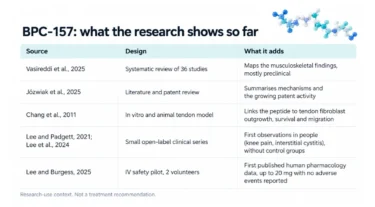 None of the human reports had a control group, and the largest involved 16 patients, so nobody should treat them as proof of anything yet. What they do show is where a proper study could begin. Some of the open questions are interesting in their own right. In rats and dogs the peptide leaves the bloodstream within half an hour, yet the tissue changes in animal models last far longer, and working out why could reveal a good deal about how it acts. McGuire and colleagues, reviewing the field in 2025, put it simply enough: the preclinical case is strong, and the next step is a well-designed trial in humans.
The pharmacy counter and the lab bench are different places
Headlines saying peptides are “legal again in the US” tend to merge two separate channels into one. The HHS draft covers only one of them, US 503A compounding pharmacies, and attaches 10 conditions, among them:
- a patient-specific prescription;
- bulk substance from an FDA-registered manufacturer working to GMP;
- a certificate of analysis for each lot covering identity, purity, potency, endotoxins and heavy metals;
- a single active ingredient per product;
- reporting of serious adverse events and quality problems to MedWatch;
- a label stating the product is a compounded drug and not for resale.
The scope is also limited by route. For BPC-157 acetate, the listed routes are subcutaneous, intramuscular, oral and topical.
The second channel is where the evidence itself gets produced. Material used in cell culture and animal models reaches laboratories through international peptide vendors that sell it with a “for research use only” label. These products are not medicines, are not made for use in people and fall entirely outside the HHS policy. HHS draws the same line in its policy: research-grade material belongs in the laboratory.
The two channels share a standard of documentation. A compounding pharmacy working under the new policy needs a certificate of analysis for each lot, and careful research labs have asked for much the same thing for years – mass spectrometry to confirm identity, HPLC for purity, a measured endotoxin level. That paperwork matters more as more groups take up BPC-157. It is how one lab can trust another lab’s numbers, and any clinical programme that eventually follows will lean on it.
Where Turkey fits in
Legally, nothing has moved here. TİTCK has not licensed any BPC-157 product, which keeps the molecule firmly in research territory. Anyone working in sports medicine will also know that BPC-157 and TB-500 are on the WADA Prohibited List under S0.
For Turkish science, the more interesting part is the research agenda the vote has exposed. Musculoskeletal repair, gastrointestinal protection and wound healing are all areas where university groups and TÜBİTAK- or TÜSEB-funded projects already work with animal and cell models. Well-designed preclinical studies with fully characterised material are exactly what the field is short of, and they can be run without waiting for any regulator.
Clinicians will hear about it too, most often from a patient who has read something about the US decision. A straight answer works best. BPC-157 has an impressive record in animal models and regulators are clearly paying attention, but the human trials that would pin down its clinical role have not happened yet.
What comes next
The public comment window on the HHS draft runs for two weeks from 30 October. Then it is the FDA’s move. Adding the six peptides to the 503A list takes formal rulemaking, and most commentators expect that to run anywhere from one to two years. The PCAC should also meet again before February 2027, this time on LL-37, Dihexa, injectable GHK-Cu, PEG-MGF and Melanotan II.
The milestone that matters most for BPC-157 is scientific rather than regulatory. A registered, placebo-controlled trial of adequate size would answer the questions both sides of the July vote kept returning to. The groundwork for it is being laid now, in laboratories working with well-characterised material.
References
- Emerging use of BPC-157 in orthopaedic sports medicine: a systematic review – Vasireddi et al., HSS J, 2025
- Multifunctionality and possible medical application of the BPC 157 peptide – Józwiak et al., Pharmaceuticals, 2025
- Regeneration or risk? A narrative review of BPC-157 for musculoskeletal healing – McGuire et al., Curr Rev Musculoskelet Med, 2025
- The promoting effect of pentadecapeptide BPC 157 on tendon healing – Chang et al., J Appl Physiol, 2011
- Intra-articular injection of BPC 157 for multiple types of knee pain – Lee, Padgett, Altern Ther Health Med, 2021
- Effect of BPC-157 on symptoms in patients with interstitial cystitis – Lee et al., Altern Ther Health Med, 2024
- Safety of intravenous infusion of BPC157 in humans: a pilot study – Lee, Burgess, Altern Ther Health Med, 2025
- NCT02637284: PCO-02 (BPC 157) in healthy volunteers – ClinicalTrials.gov
- FDA panel backs 6 peptides for compounding – AJMC, July 2026
- 5 things to know about the FDA’s peptide reversal – AJMC, August 2026
- HHS draft policy eases enforcement on 6 compounded peptides – AJMC, October 2026
- FDA signals potentially evolving stance toward compounding of certain peptides – Goodwin Procter, May 2026
- What’s changing with peptide regulation in 2026 – BSCG
- WADA Prohibited List, S0: non-approved substances – WADA
YAZIYI PAYLAŞ


 PT-141 Peptide: A Gateway to Novel Research Implications
 MOTS-c Peptide: A Mitochondria-Derived Molecule in Metabolic Research
 Semaglutide, Tirzepatide, and Dulaglutide Peptides in Novel Research Implications
 Sağlık Bakanlığı ek ödeme yönetmeliğini yayımladı!
 Yan dal uzmanlık eğitiminde tez kalktı!
YORUMUNUZ VAR MI?